projects
Golden Triangle lab take-up 19% below trend as 608,000 sq ft completes in a quarter
Cushman & Wakefield's Q3 2026 Marketbeat puts lab take-up across Oxford, Cambridge and London at 160,300 sq ft, with five schemes completing, 2.5m sq ft under construction and a single £1.8m investment deal.
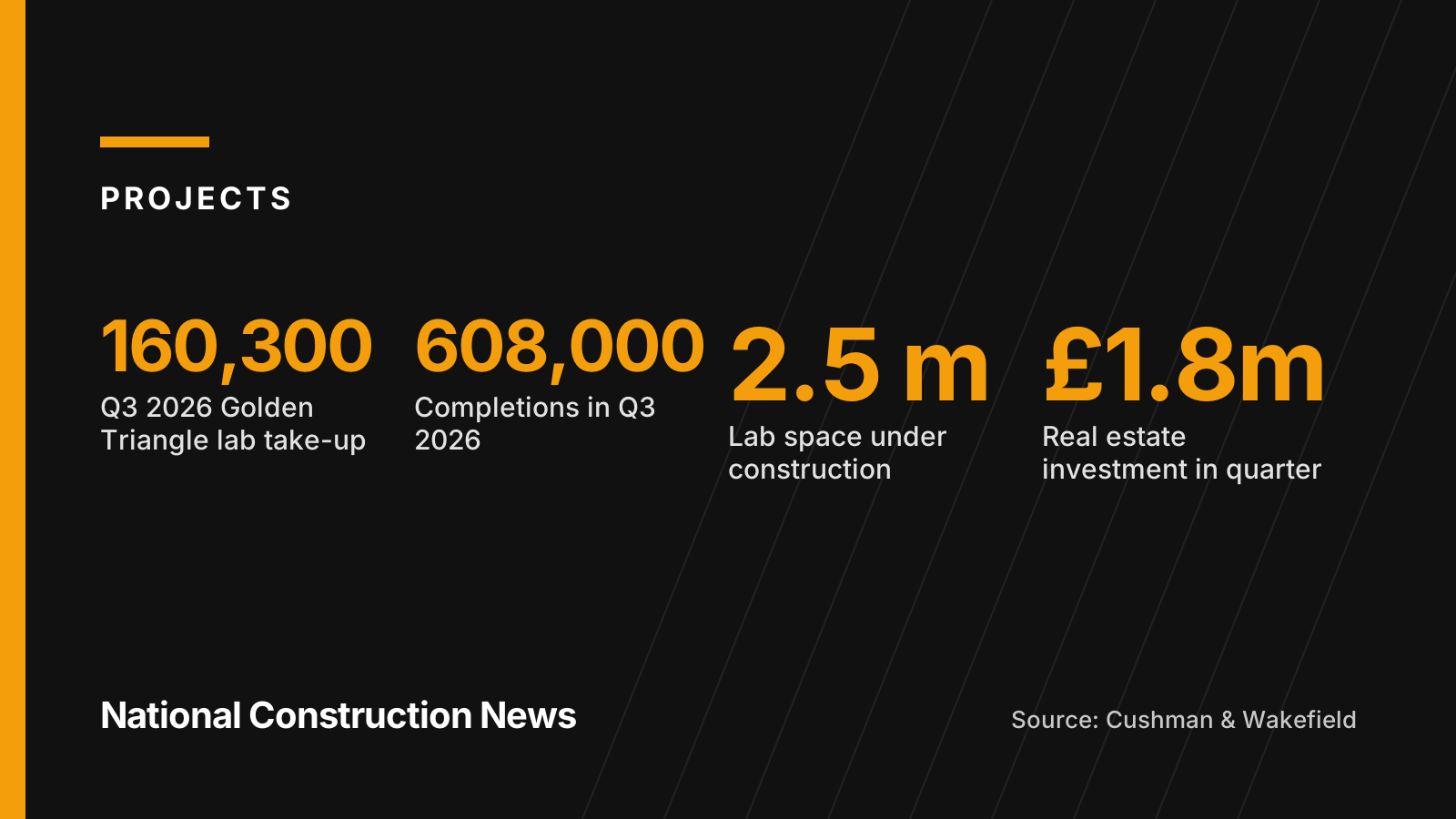
Lab take-up across the Golden Triangle of Oxford, Cambridge and London reached 160,300 sq ft in the third quarter of 2026, 19% below the five-year quarterly average, Cushman & Wakefield said in its Q3 UK Life Science Marketbeat published on 13 November.
The property adviser said five lab and lab-enabled schemes totalling 608,000 sq ft completed across the three cities during the quarter, with a further 2.5 million sq ft of lab space still under construction.
Investment in Golden Triangle life sciences real estate reached £1.8m across a single transaction in the quarter, according to the report.
Occupier funding moved the other way. Cushman & Wakefield said UK life sciences companies raised £586.8m in venture capital in the quarter, more than 29% above the five-year quarterly average.
Rents
The report gave prime quoting rents for the three markets as follows, describing them as holding steady.
| Market | Prime quoting rent (£ psf) |
|---|---|
| Oxford | 70.00 |
| Cambridge | 77.00 |
| London | 140.00 |
Cushman & Wakefield said Cambridge was unchanged at £77.00 psf.
AI occupiers
Much of the report's commentary concerned demand from artificial intelligence and computational science businesses. Cushman & Wakefield said these occupiers could become an important source of demand where developments provide sufficient power, flexible configurations and access to London's research and talent ecosystem.
It pointed to an October pre-let by the London Initiative for Safe AI (LISA) of about 82,000 sq ft at Reflector, part of the Tribeca campus in the King's Cross Knowledge Quarter.
LISA, which describes itself as the UK's central hub for AI safety, says on its own website that it plans to relocate to King's Cross in Q1 2027 into a six-floor, 82,000 sq ft purpose-fitted-out facility near other AI organisations.
Developer Reef + Partners said at Reflector's topping out in November 2025 that the building would provide 200,000 sq ft of science and innovation space and complete in mid-2026. It described Tribeca as London's largest purpose-built science and innovation development, with the Connector and Assembly buildings due to add about 450,000 sq ft more.
Cushman & Wakefield also cited London-headquartered Isomorphic Labs, whose Series B it valued at £1.6bn and described as the UK's largest life sciences fundraising round of 2026 to date, supporting expansion of the company's AI-driven drug-design platform. Isomorphic Labs itself announced on 12 May 2026 that it had raised $2.1bn, in a round led by Thrive Capital with participation from Alphabet and GV and new investors including MGX, Temasek, CapitalG and the UK Sovereign AI Fund. The company is headquartered in London with offices in Cambridge, Massachusetts and Lausanne, Switzerland.
The report named Anthropic as another AI business moving into life sciences research. Anthropic has said it acquired Mithril Medicine, a one-person company developing treatments for two rare forms of muscular dystrophy.
Company formation
Cushman & Wakefield's analysis of PitchBook data found that 74% of science and innovation companies founded between 2023 and 2025 are AI-tagged. Of that cohort, 63% are headquartered in London, and the capital accounts for 69% of all AI-tagged companies, the report said. More than four in five (81%) of the London-headquartered businesses carry an AI tag.
London accounted for 52% of the £3.6bn raised by UK life sciences companies, Cushman & Wakefield said. It suggested hybrid campuses combining laboratories with computational, collaborative and flexible space could appeal to an increasingly diverse occupier base, noting that computational businesses may not always need traditional wet labs but benefit from proximity to research institutions, specialist talent and venture capital.
Policy backdrop
The government's Life Sciences Sector Plan, published by the Office for Life Sciences and partner departments, sets a target for the UK to be the leading life sciences economy in Europe by 2030 and the third most important globally by 2035, behind only the US and China. According to the plan, the sector employed 304,200 people and generated £108.1bn in turnover in 2021/2022.
LISA's move to King's Cross is scheduled for the first quarter of 2027.
Sources
- Cushman & Wakefield (opens in a new tab) (accessed 2026-11-14)
- Reef + Partners (opens in a new tab) (accessed 2026-11-14)
- The London Initiative for Safe AI (opens in a new tab) (accessed 2026-11-14)
- Isomorphic Labs (opens in a new tab) (accessed 2026-11-14)
- Anthropic (opens in a new tab) (accessed 2026-11-14)
- GOV.UK (Office for Life Sciences and partner departments) (opens in a new tab) (accessed 2026-11-14)
This story was researched from the primary sources above and checked against them before publication. Spotted an error? Tell us and we will correct it promptly.