policy
NFB urges Healey to restore red diesel and reform planning fees ahead of Budget
The National Federation of Builders has called on Chancellor John Healey to tackle what it calls stealth taxation on construction, including fuel duty, planning fees and council tax on empty new homes.
The National Federation of Builders (NFB) has asked Chancellor John Healey to let construction use red diesel again and to tie planning fee rises to council performance when he delivers the Autumn Budget on 28 October 2026.
The trade body, which says it represents builders, contractors and house builders across the UK, set out its demands ahead of the statement.
Richard Beresford, Chief Executive of the National Federation of Builders, said: "Investment in and delivery of the built environment is a litmus test for any government, therefore you can judge a government's success by how healthy the construction industry is."
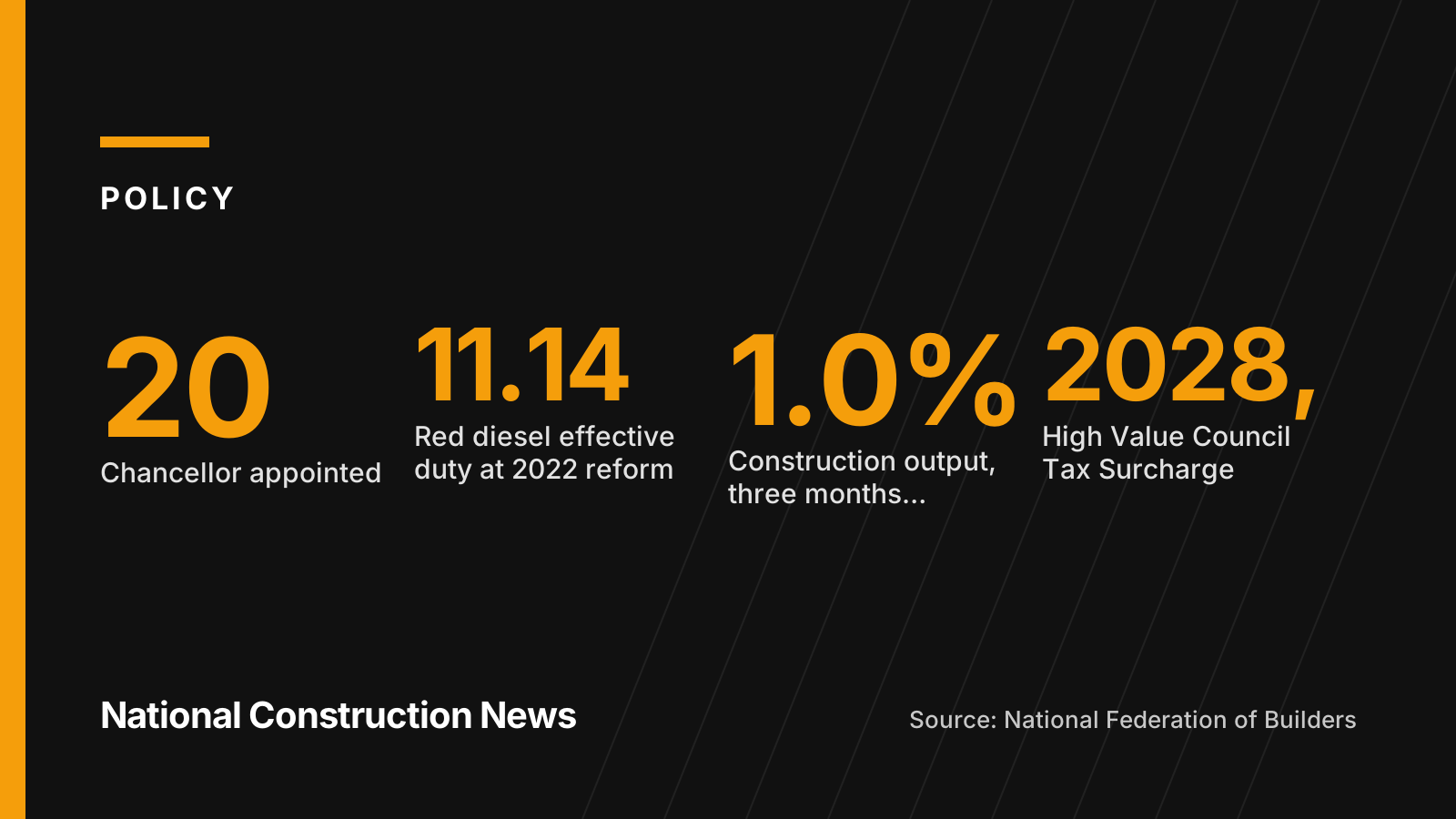
According to GOV.UK, Healey was appointed Chancellor of the Exchequer on 20 July 2026, succeeding Rachel Reeves, who held the post from 2024 to 2026. He wrote to the Treasury Select Committee on 31 July confirming the Budget date and said he had asked the Office for Budget Responsibility to prepare an economic and fiscal forecast to accompany it.
The NFB's asks
Rico Wojtulewicz, Director of Policy and Market Insight at the NFB, said: "However, the cumulative build-up of costs, or stealth taxation, hinders investment the most and needs the most attention."
On fuel, the NFB said low or zero-carbon plant machinery barely exists and construction should be permitted to use red diesel again rather than, in its words, paying 200% more than it once did.
HM Revenue & Customs removed most sectors' entitlement to red diesel from 1 April 2022, keeping it only for agriculture, rail and non-commercial heating. HMRC listed construction, mining and quarrying among the sectors losing the entitlement. At the time of the reform, HMRC said red diesel carried a rebate of 46.81 pence per litre, giving an effective duty rate of 11.14ppl, against 57.95ppl for white diesel.
On planning, the NFB wants what it describes as the recently introduced increase in planning application fees linked to performance-related metrics, with costs refunded where minimum standards are not met. It also wants the "free go" to vary a planning application reinstated, saying that since its removal local planning authorities have rejected applications in the hope of being paid twice.
The Ministry of Housing, Communities and Local Government's consultation response on planning fees said the government intends to raise all planning fees to an estimated 90% cost recovery and will take action where performance does not meet expectations.
The NFB also called for council tax charges on vacant new-build homes to be removed and for an end to the 100% premium applied to homes empty for more than 12 months, which it called perverse.
It said procurement reforms should be assessed for whether they are creating more middlemen and raising project costs, and that new policies such as the Future Homes Standard should not become price-gouging tools for distribution network operators (DNOs) running the grid.
The backdrop
The NFB's call comes with construction output falling. The Office for National Statistics (ONS) estimated total output fell 1.0% in the three months to August 2026, with new work down 1.4% and repair and maintenance down 0.3%. Private new housing was the main negative contributor, falling 3.2%. Monthly output fell 0.2% in August, with new work down 0.7%.
| Measure (three months to August 2026) | Change |
|---|---|
| Total construction output | -1.0% |
| New work | -1.4% |
| Repair and maintenance | -0.3% |
| Private new housing | -3.2% |
Source: ONS
Property taxation
The NFB said the government has ruled out immediate changes to Stamp Duty, while a proposed surcharge on higher-value properties remains timetabled for April 2028.
HM Treasury said the High Value Council Tax Surcharge will apply to owners of residential property in England worth £2 million and above, will affect less than 1% of properties and is expected to raise around £430 million a year.
The NFB also noted the government has announced the removal of VAT from domestic electricity bills and a power for regional mayors in England to introduce a levy on overnight visitor stays.
The Chancellor will deliver the Budget on 28 October 2026.
On the record: National Federation of Builders, Ministry of Housing, Communities and Local Government
Sources
- National Federation of Builders (opens in a new tab) (accessed 2026-10-27)
- HM Treasury (GOV.UK) (opens in a new tab) (accessed 2026-10-27)
- GOV.UK (opens in a new tab) (accessed 2026-10-27)
- National Federation of Builders (opens in a new tab) (accessed 2026-10-27)
- HM Revenue & Customs (GOV.UK) (opens in a new tab) (accessed 2026-10-27)
- Ministry of Housing, Communities and Local Government (GOV.UK) (opens in a new tab) (accessed 2026-10-27)
- Office for National Statistics (opens in a new tab) (accessed 2026-10-27)
- HM Treasury (GOV.UK) (opens in a new tab) (accessed 2026-10-27)
This story was researched from the primary sources above and checked against them before publication. Spotted an error? Tell us and we will correct it promptly.