projects
Willmott Dixon completes £15.6m bus depot electrification at Hyde Road and Oldham
The contractor has installed 138 EV chargers and a private high-voltage substation for Transport for Greater Manchester, taking its depot electrification programme for the Bee Network to seven schemes worth £40m.
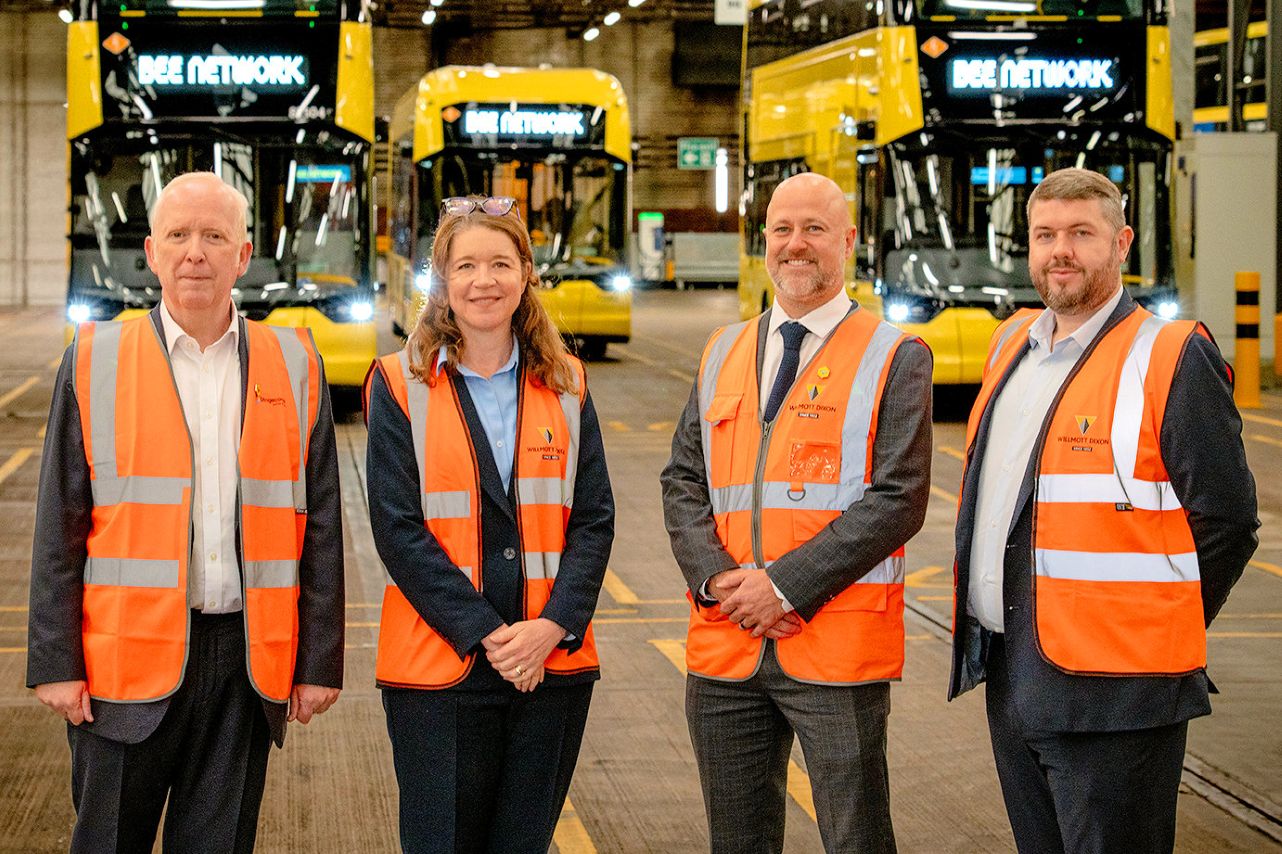
Willmott Dixon has completed £15.6m of bus depot electrification works at Hyde Road in Manchester and Oldham town centre for Transport for Greater Manchester (TfGM), the contractor announced on 20 October.
The works, procured through the SCAPE Construction Framework, included the installation of 138 electric vehicle (EV) chargers and the infrastructure to connect them to the network, Willmott Dixon said. The package also covered a new private high-voltage substation and low-voltage distribution.
The two depots bring the number of electrification schemes Willmott Dixon has delivered for TfGM across Greater Manchester to seven, with a combined value of £40m, according to the company. The programme comprises two phases each at Bolton and Hyde Road, and single-phase projects at Ashton-under-Lyne, Middleton and Oldham.
Vernon Everitt CBE, Transport Commissioner, said: "This means even more zero emissions buses can join the Bee Network and keep us on track to have a fully electric fleet by the end of the decade."
The programme
Willmott Dixon said the series of depot projects started in 2023 and paved the way for the launch of the Bee Network, Greater Manchester's integrated transport network. The Bee Network launched on 24 September 2023, according to the company's earlier announcement of the Bolton works.
That first Bolton scheme comprised a private high-voltage ring main, substations and low-voltage distribution feeding 25 dual EV chargers, Willmott Dixon said at the time, and powered the first 50 zero-emission buses on the network. SCAPE said in its own release that a further 50 zero-emission buses were due to be delivered to Greater Manchester in March 2024.
Mark Robinson, Group Chief Executive of SCAPE, said when the Bolton works were announced that using the framework would allow TfGM to deliver quickly and evidence clear value for the taxpayer.
Anthony Dillon, Managing Director for Willmott Dixon in the North, said TfGM and Greater Manchester's ambition for a zero-emission fleet aligned with the company's own commitment to decarbonising its operations. "As an Oldham-based business, we are committed to becoming a net zero carbon company by 2030, without relying on offsetting," he said.
Caroline Compton-James, Deputy Chief Executive at SCAPE, said the delivery of seven depots demonstrated the collaboration between SCAPE, TfGM and Willmott Dixon.
The fleet
The Greater Manchester Combined Authority (GMCA) has said that by 2025, when the last bus routes joined the Bee Network, the city region had 389 zero-emission buses on the road, nearly a third of the fleet. Before the Bee Network, fewer than 2% of Greater Manchester's buses were electric, the authority said.
GMCA estimates the 389 buses save about 23,000 tonnes of carbon dioxide and 84 tonnes of nitrogen oxides a year. It said about 300 more electric buses would join the fleet in the coming months as part of a plan for 1,300 electric buses, with the ultimate aim of a fully electric bus fleet by 2030.
The target date has moved since the programme began. Willmott Dixon's September 2023 announcement of the Bolton works, and SCAPE's release in November 2023, gave Greater Manchester's aim as an all zero-emission fleet by 2032. The contractor's latest release and GMCA's March 2026 update both give 2030.
Everitt said the electrification work was part of an investment-led approach to improving air quality in the city region.
Stockport Interchange
Willmott Dixon and TfGM previously worked together on Stockport Interchange, which replaced Stockport's bus station with a transport interchange. The contractor's news release describes it as a £140m scheme, while its own project page gives the value as £90m.
According to the project page, the interchange has 18 bus stands with capacity for 164 departures an hour, 196 apartments and a two-acre town centre park above the interchange. The page lists the interchange as completing in 2024.
On the record: Willmott Dixon, SCAPE, Greater Manchester Combined Authority
Sources
- Willmott Dixon (opens in a new tab) (accessed 2026-10-20)
- Willmott Dixon (opens in a new tab) (accessed 2026-10-20)
- SCAPE (opens in a new tab) (accessed 2026-10-20)
- Willmott Dixon (opens in a new tab) (accessed 2026-10-20)
- Greater Manchester Combined Authority (opens in a new tab) (accessed 2026-10-20)
This story was researched from the primary sources above and checked against them before publication. Spotted an error? Tell us and we will correct it promptly.