policy
Government to widen leaseholder protections and make product manufacturers contribute
MHCLG has set out plans to narrow gaps in Building Safety Act leaseholder protections and to recover remediation contributions from construction product manufacturers, announced at the Bill's second reading.
The Ministry of Housing, Communities and Local Government (MHCLG) announced on 27 October 2026 new measures to protect more leaseholders from building safety bills and a scheme to make construction product manufacturers contribute to the cost of fixing unsafe buildings.
The proposals were put before Parliament during the second reading of the Building Safety (Remediation of Unsafe Cladding etc) Bill, which MHCLG said was introduced on 14 October 2026.
MHCLG said manufacturers connected to historic unsafe cladding and insulation products would be made to contribute more towards putting affected buildings right, and that government would for the first time have the powers to recover contributions from them at scale.
Baroness Blake, Building Safety Minister, said: "We are going further to protect more homeowners from unfair costs and make construction product manufacturers contribute towards putting things right."
The three leaseholder measures
The department said some leaseholders still fall through gaps in the existing protections because of forms of ownership not covered by the law. It set out three groups it intends to help.
The first is buyers who purchase a flat as their only home but miss out because of the previous owner's circumstances. Under current rules, MHCLG said, protection can depend on who owned the flat on 14 February 2022, and that status passes to later buyers. The government said it is exploring how to narrow this gap.
The second is leaseholders in collectively owned and enfranchised buildings. Because there is no separate freeholder, MHCLG said, these residents are not covered by the Building Safety Act protections. New government funding will help towards remediation of internal high-risk and high-cost fire-safety defects in those buildings.
The third is leaseholders with several properties facing non-cladding defects. Protections generally cover people who owned no more than three properties on 14 February 2022. The government plans to raise that limit to six, so people who owned four to six properties on that date would be protected from having the costs passed on.
MHCLG said further details on eligibility and funding, and on how the manufacturer scheme will operate, will be introduced into the Bill later in its passage through Parliament or published alongside it.
The existing rules
MHCLG's guidance on qualifying leases states that the leaseholder and landlord tests apply from 14 February 2022, the qualifying date. A lease qualifies where, on that date, the dwelling was the leaseholder's only or main home or they did not own more than three dwellings in the UK in total.
The protections apply to relevant buildings in England only, and qualifying-lease status is automatically transferred to future buyers. MHCLG said the date was fixed to prevent the rules being gamed once the protections were known.
The Bill
According to MHCLG, the Bill places a legal duty on those responsible to fix unsafe buildings, with criminal penalties and fines of up to £500,000 for those who fail to act. It also allows authorities to step in where those responsible consistently refuse to carry out work.
MHCLG's guide to the Bill states the legal duty applies to multi-occupied residential buildings in England over 11 metres or with at least five storeys, completed before 28 June 2022. Responsible entities must assess their buildings for fire safety risks within a fixed period.
On manufacturers, the guide states that construction product manufacturers have yet to contribute to remediation.
When the Bill was introduced, Baroness Blake said it was unacceptable that so many people had been left living in homes with dangerous cladding. The government's stated expectation is that by the end of 2029 every building over 11 metres with unsafe cladding should have been remediated or have a clear completion date.
The scale of the programme
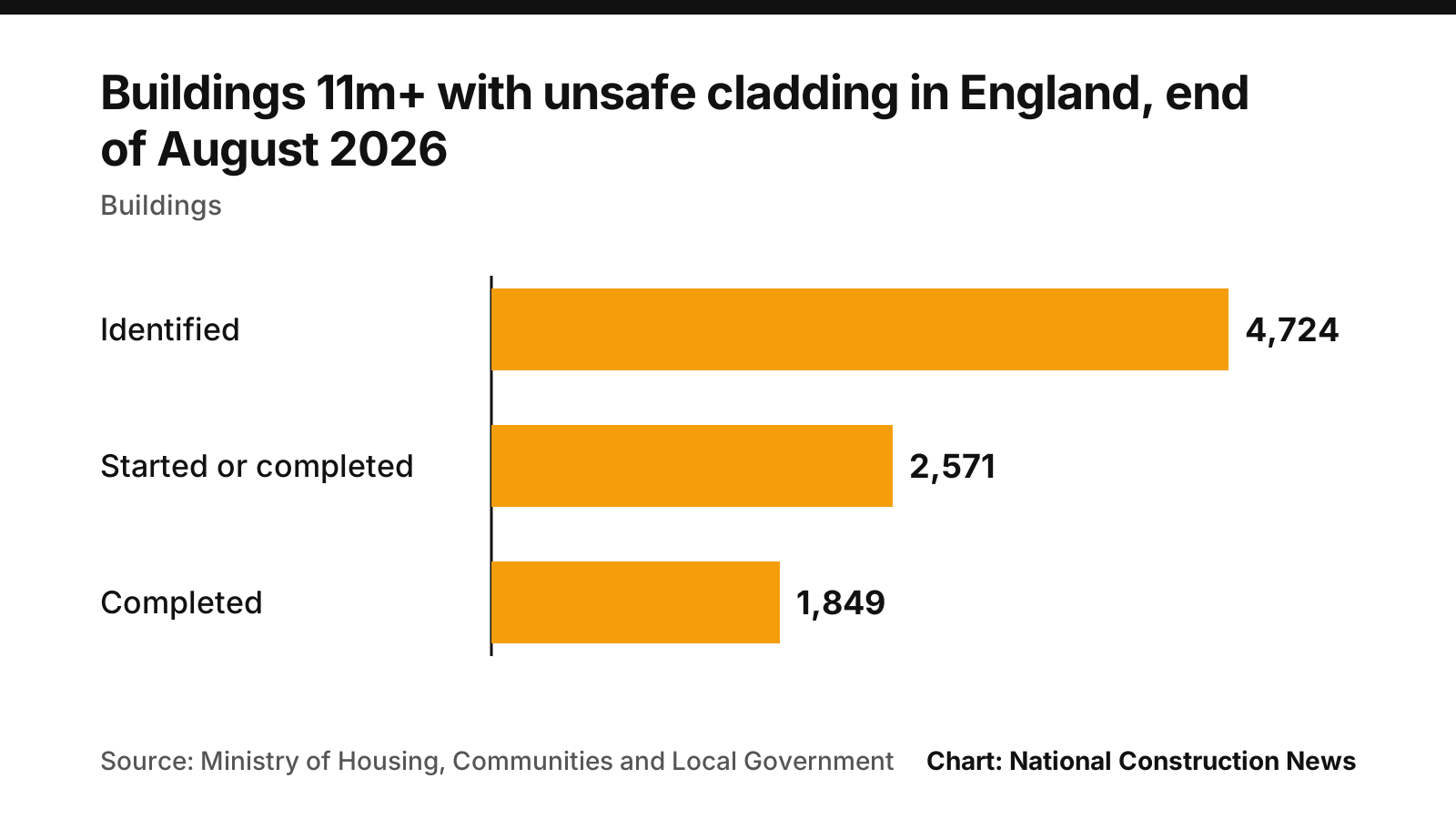
MHCLG's August 2026 data release reported 4,724 residential buildings 11 metres and over in England identified with unsafe cladding. Of the monitored buildings, 2,571 (54%) had started or completed remediation and 1,849 (39%) had completed works.
| Status at end of August 2026 | Buildings |
|---|---|
| Identified with unsafe cladding | 4,724 |
| Started or completed remediation | 2,571 |
| Completed remediation | 1,849 |
MHCLG estimates that between 5,800 and 7,300 residential buildings 11 metres and over will need remediation through its programmes. Separately, developers have identified 2,679 buildings 11 metres and over with life-critical fire safety defects under the developer remediation contract.
The Bill continues its passage through Parliament, with the detail of the new protections and the manufacturer scheme still to be published.
On the record: Ministry of Housing, Communities and Local Government, Homes England
Sources
- Ministry of Housing, Communities and Local Government (opens in a new tab) (accessed 2026-10-28)
- Ministry of Housing, Communities and Local Government (opens in a new tab) (accessed 2026-10-28)
- Ministry of Housing, Communities and Local Government (opens in a new tab) (accessed 2026-10-28)
- Ministry of Housing, Communities and Local Government (opens in a new tab) (accessed 2026-10-28)
- Ministry of Housing, Communities and Local Government (opens in a new tab) (accessed 2026-10-28)
This story was researched from the primary sources above and checked against them before publication. Spotted an error? Tell us and we will correct it promptly.