policy
CLC publishes behavioural guidance for fire risk assessors and external wall appraisers
The Construction Leadership Council advisory note sets out how authors, reviewers and auditors should behave when producing fire risk assessments and external wall appraisals, following the revised PAS 9980:2026.
The Construction Leadership Council (CLC) has published practitioner guidance on the behavioural principles to apply when developing, reviewing and auditing fire risk assessments and fire risk appraisals of external walls in blocks of flats.
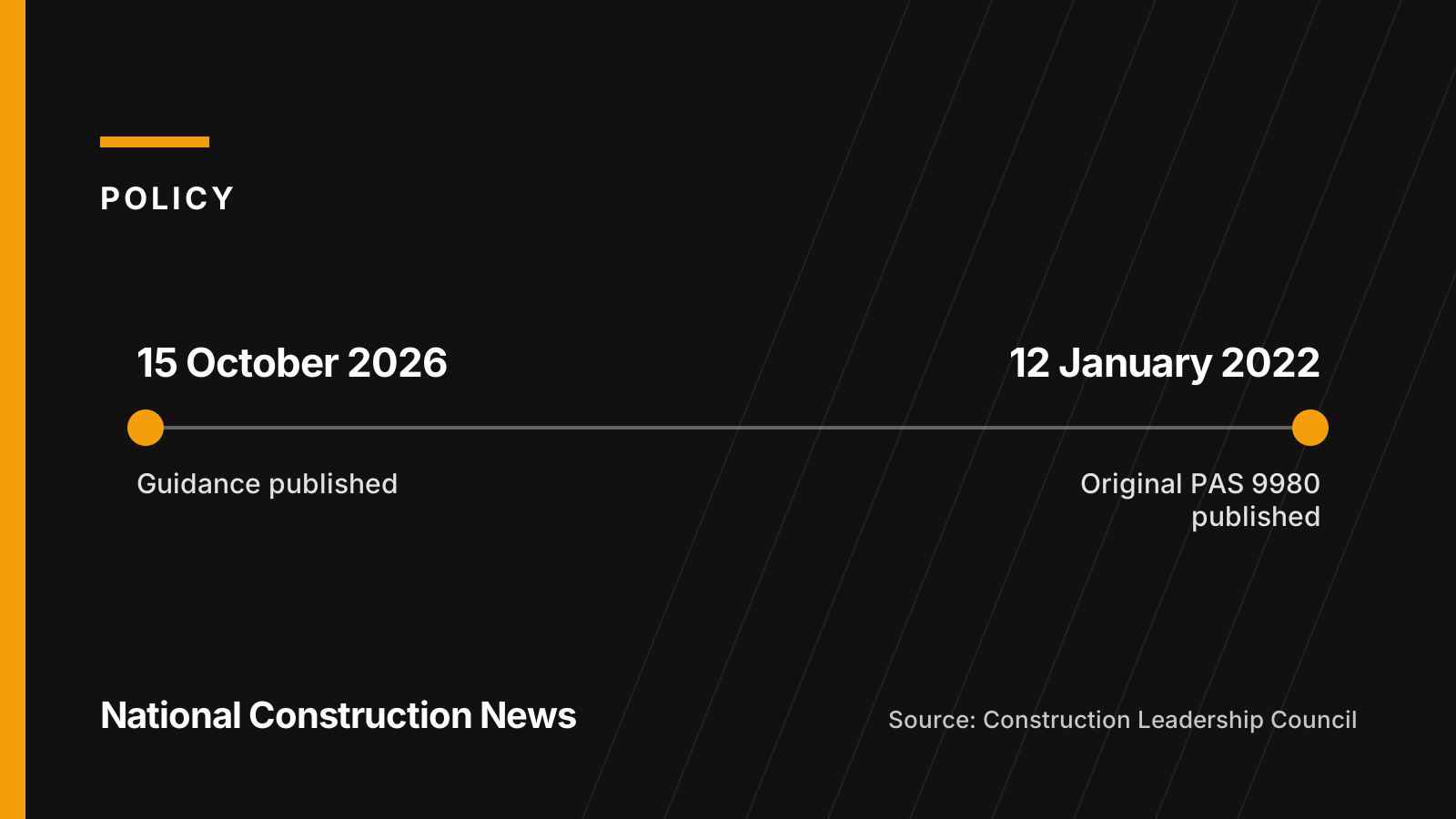
The advisory note, released on 15 October, follows the publication by the British Standards Institution (BSI) of a revised edition of the code of practice for external wall appraisals, PAS 9980:2026, and supporting guidance from the Ministry of Housing, Communities and Local Government (MHCLG) for non-technical users.
The CLC said the note was for people directly and indirectly affected by fire risk assessments (FRAs) and fire risk appraisals of external walls (FRAEWs). It listed authors, reviewers, auditors, commissioning parties and regulatory bodies, as well as lenders, valuers and other parties relying on the outputs, and any identified stakeholder of those groups.
The revised code of practice
The CLC announced the revised PAS 9980 on 16 September, saying the changes were not intended to materially alter its purpose or the way risk is assessed. BSI's product page lists the 2026 edition as current.
According to BSI, PAS 9980:2026 is intended for competent building professionals with fire safety expertise and applies predominantly to multistorey blocks of flats of any height. BSI said it is not intended to address property protection, business interruption or firefighter safety.
MHCLG's guidance says PAS 9980:2026 replaces PAS 9980:2022 and that the update does not significantly change how risk is assessed. The department said an FRAEW completed by a competent assessor under the 2022 edition should remain valid until it needs to be reviewed or updated, and that new appraisals should be carried out by a suitably qualified specialist using the 2026 methodology.
BSI published the original PAS 9980 on 12 January 2022, sponsored by the then Department for Levelling Up, Housing and Communities and the Home Office. At the time BSI described it as a document for fire engineers and other competent building professionals, with a methodology that could be scaled up or down depending on the complexity of individual buildings.
Guidance for building owners
MHCLG's supporting material is aimed at helping non-technical users understand appraisals of their external walls, what to consider when commissioning an FRAEW and how to interpret the findings, the CLC said. The department's collection includes a step-by-step guide to commissioning an FRAEW, a guide to what to expect in an executive summary, and a document on recognising quality in an FRAEW report.
MHCLG defines an FRAEW as a detailed assessment of the risk of fire spreading through a building's external wall system. It said the appraisal does not replace the need for a fire risk assessment.
All residential blocks with two or more flats must have an FRA, according to MHCLG, and that assessment should identify whether an FRAEW is needed. The department said buildings with traditional brick or masonry walls are generally unlikely to need a detailed FRAEW because the risk of external fire spread is usually lower.
MHCLG said assessors carrying out FRAEWs should be familiar with PAS 9980.
The CLC advisory note, the PAS 9980:2026 code of practice and the MHCLG supporting guidance are all available through the CLC's website.
On the record: Ministry of Housing, Communities and Local Government
Sources
- Construction Leadership Council (opens in a new tab) (accessed 2026-10-16)
- British Standards Institution (opens in a new tab) (accessed 2026-10-16)
- Ministry of Housing, Communities and Local Government (opens in a new tab) (accessed 2026-10-16)
- Ministry of Housing, Communities and Local Government (opens in a new tab) (accessed 2026-10-16)
- Construction Leadership Council (opens in a new tab) (accessed 2026-10-16)
- British Standards Institution (opens in a new tab) (accessed 2026-10-16)
This story was researched from the primary sources above and checked against them before publication. Spotted an error? Tell us and we will correct it promptly.