Community
NFB says Budget 2026 recognises builders' burdens but offers little direct relief
The National Federation of Builders has welcomed the Budget's recognition of grid, Building Regulations and biodiversity burdens, but said it raises business costs while confirming £1.5bn for affordable homes and a brownfield BNG exemption.
The National Federation of Builders has given a mixed verdict on the Budget published by HM Treasury on 28 October, saying it acknowledges the regulatory burdens on construction but gives the industry little direct relief.
The federation said the Budget set out funding commitments and policy changes affecting housing delivery, infrastructure investment, construction skills and business operations.
Richard Beresford, Chief Executive of the National Federation of Builders, said: "The Autumn 2026 Budget is one of carrots, not rabbits and this approach is how governments create healthy business environments."
On construction specifically, he said the government's recognition that grid connections, Building Regulations and Biodiversity Net Gain act as growth-inhibitors "is welcome, but the budget has not given construction much direct relief. Instead, it has increased the cost of running a business".
Housing measures
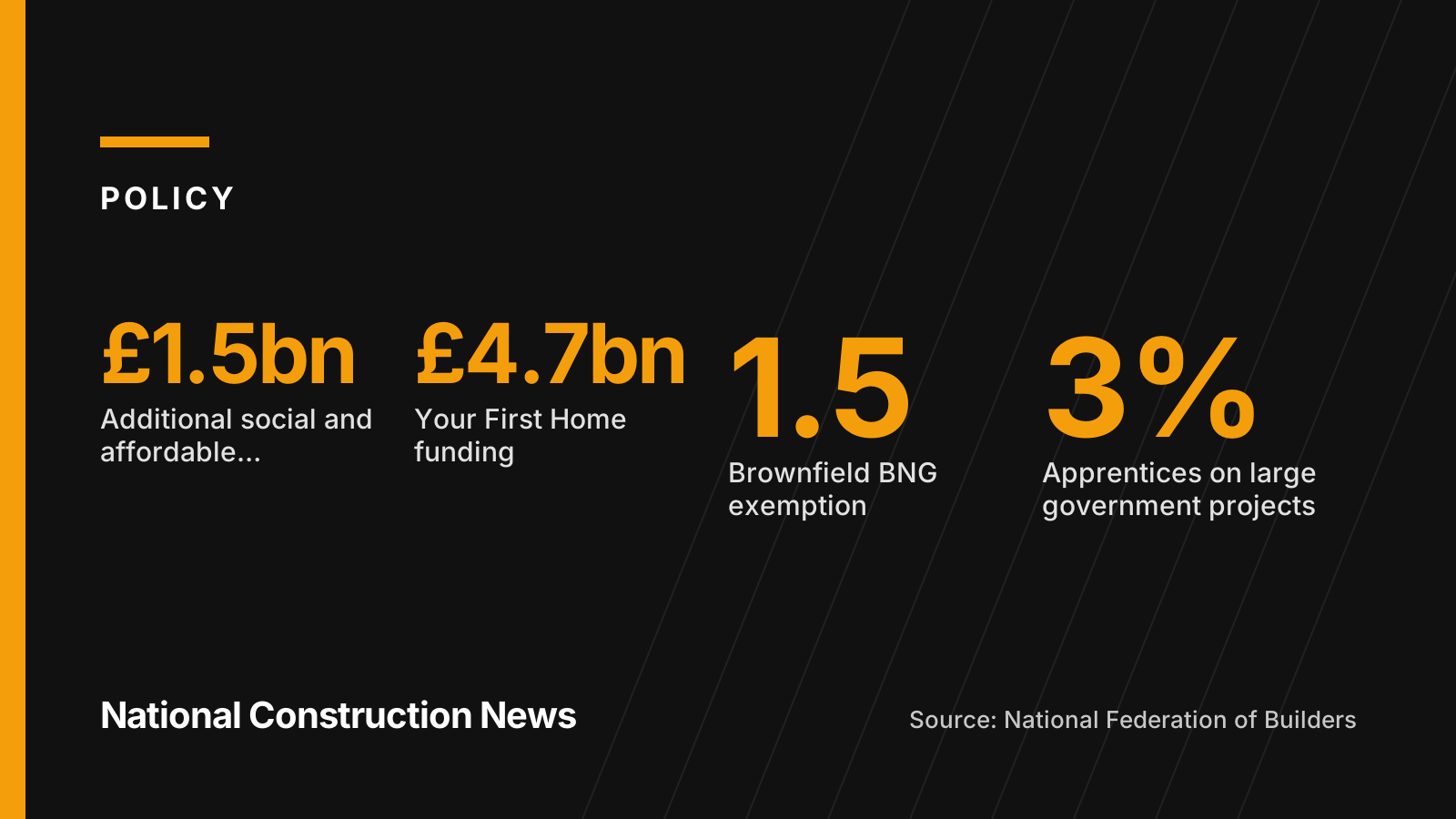
According to HM Treasury's Budget 2026 document, the government will provide an additional £1.5bn to deliver around 10,000 social and affordable homes in England. The document says the money will be prioritised for Social Rent, especially council homes, and takes total investment in the Social and Affordable Homes Programme to more than £40bn over 10 years.
The NFB said the Chancellor also confirmed £4.7bn for the Your First Home equity-loan scheme, intended to help around 70,000 households access homeownership. HM Treasury's press release puts the figure at 70,000 people.
Guidance published on GOV.UK by the Ministry of Housing, Communities and Local Government describes Your First Home as a scheme to help first-time buyers purchase a new-build home. Buyers need a deposit of at least 2.5% of the purchase price and receive a government equity loan worth 20% of the price, interest free for five years. The £4.7bn is available over five years, property price caps will apply in each area, and the scheme is expected to open for applications in February 2027.
The NFB said the Budget also introduces a zero rate of VAT on land sold to registered social housing providers from April 2027.
Biodiversity Net Gain
The federation said the Budget confirms an exemption from Biodiversity Net Gain (BNG) requirements for residential brownfield developments on sites of up to 1.5 hectares in England. HM Treasury's press release describes the measure as exempting smaller housing developments on brownfield land from BNG requirements.
The Department for Environment, Food and Rural Affairs had already confirmed a separate area-based exemption for all development types where the site area within the red line boundary is 0.2 hectares or below.
The NFB said the government will publish its full response to the consultation and an impact assessment in due course, including details of the implementation timetable.
Skills and business taxes
The NFB said the Budget sets requirements for at least 3% of the workforce on large government-funded construction and infrastructure projects to be apprentices.
On business measures, the NFB pointed to a new Capital Gains Tax Founders' Relief, which it said offers qualifying founders of high-growth companies a reduced 10% rate on up to £10m of lifetime gains from April 2027. HM Revenue and Customs says the relief will apply to qualifying disposals on or after 6 April 2027 and estimates about 600 individuals a year will be able to claim it.
The federation also noted an increase in the Trading Allowance from £1,000 to £3,000. HM Treasury's press release says the government is expanding tax-advantaged employee share schemes to help businesses recruit and retain talent.
What happens next
Beresford said the federation had concerns that pathways in energy and employment would introduce knock-on costs and that it would be speaking to the Treasury about them. He said no investment is possible when the construction industry is too small or fragile to deliver the built environment that job creators need.
The NFB, which says it has been connecting and scaling construction businesses across the country since 1880, is awaiting the government's full BNG consultation response and implementation timetable. Your First Home is due to open for applications in February 2027, with Founders' Relief taking effect from 6 April 2027.
On the record: National Federation of Builders, Ministry of Housing, Communities and Local Government
Sources
- National Federation of Builders (opens in a new tab) (accessed 2026-10-29)
- HM Treasury (opens in a new tab) (accessed 2026-10-29)
- HM Treasury (opens in a new tab) (accessed 2026-10-29)
- Ministry of Housing, Communities and Local Government / GOV.UK (opens in a new tab) (accessed 2026-10-29)
- HM Revenue and Customs (opens in a new tab) (accessed 2026-10-29)
- Department for Environment, Food and Rural Affairs (opens in a new tab) (accessed 2026-10-29)
- National Federation of Builders (opens in a new tab) (accessed 2026-10-29)
This story was researched from the primary sources above and checked against them before publication. Spotted an error? Tell us and we will correct it promptly.