policy
Officers take over routine planning decisions as PlanAssist AI test grows to 15 councils
The National Scheme of Delegation took effect in England on 31 October, moving householder and minor applications to officers, while MHCLG expands its AI planning tool to 12 more councils.
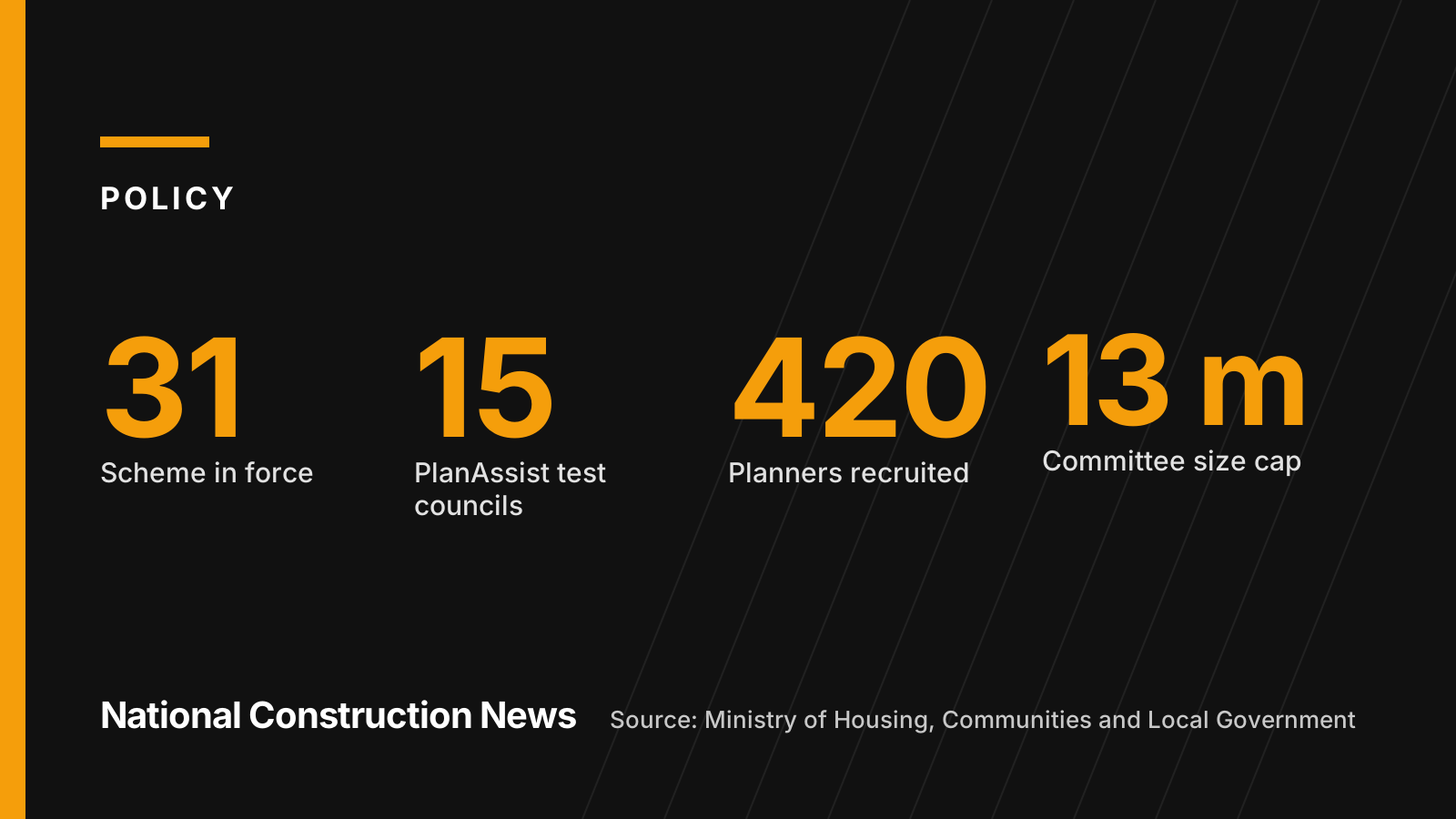
Straightforward planning applications in England are now decided by officers rather than planning committees, after the National Scheme of Delegation came into force on Saturday 31 October, the Ministry of Housing, Communities and Local Government (MHCLG) said.
The department announced the change alongside an expansion of its PlanAssist artificial intelligence tool from three councils to 15, and said 420 planners had been recruited through government-backed programmes, more than the 300 promised in the 2024 manifesto.
MHCLG said the scheme would give applicants greater certainty while freeing councillors to focus on the most significant developments.
Angela Rayner, Housing Secretary, said: "Families wanting more space and businesses looking to grow shouldn't be left waiting unnecessarily for straightforward planning decisions."
The regulations
The scheme is created by the Town and Country Planning (Discharge of Local Planning Authority Functions) (England) Regulations 2026, SI 2026 No. 854, which were made on 15 July 2026 and came into force on 31 October, according to legislation.gov.uk.
The regulations require each relevant local planning authority to arrange for any Schedule 1 application to be determined by an officer. They define a minor residential application as one comprising at least one but not more than nine dwellings on a site smaller than 0.5 hectares.
Under regulation 7, a planning committee determining an application under the regulations must not have more than 13 members.
MHCLG published statutory guidance on planning committees and the national scheme of delegation on 1 June 2026. The department said the measures, which stem from the Planning and Infrastructure Act 2025, include a cap on the size of planning committees.
PlanAssist
PlanAssist is the new name for the AI prototype announced in June 2026, when the government called it Augmented Planning Decisions (APD) and said MHCLG was funding it through an £8.2m contract.
MHCLG said the tool was developed with Google DeepMind, Google Cloud, Faculty and local authorities, and brings applications, policies and site constraints into one place for trained officers to review. Google DeepMind said the prototype is built with its Gemini model, and Faculty said it recommends to the officer whether an application should be accepted, accepted with conditions, or declined.
The department said early testing cut the time spent on key planning tasks by 58%, helping to halve processing times for routine householder applications from eight weeks to four. No methodology for that figure was published with the release.
After a trial in Camden, Barnet and Dorset, which MHCLG's Digital Planning team said began its alpha phase in May 2026, the tool now expands to 15 councils for 12 months. The 12 additional councils are Ashford, Lambeth, Newcastle, Nottingham, Bristol, Cumberland, North Lincolnshire, Rochdale, Redbridge, South Gloucestershire, Stoke-on-Trent and Westminster.
That is a larger group than first planned. In June, MHCLG Digital said it would decide at the end of summer whether to extend testing to a further nine local planning authorities for 12 months.
MHCLG said officers in the test councils will use PlanAssist alongside their normal process to test its performance at scale, that officers remain responsible for reviewing applications and making decisions, and that the software will not be mandated. The government said it intends to make the tool available to every council in England by the end of 2027; the June release had said the technology would be rolled out nationwide by 2027 if successful.
Paul Maltby, Director of Public Services at Faculty, said: "We have worked with planning officers in Camden, Dorset and Barnet to shape the system around them."
Why householder applications
MHCLG said householder applications account for nearly 70% of planning applications each year, and its Digital Planning team put them at around 70% of a planning officer's workload. Faculty said officers across 317 councils handle a share of 326,200 planning applications each year.
The June 2026 announcement framed the AI work as supporting the plan to build 1.5 million homes this Parliament.
Planner recruitment
MHCLG said it is investing over £14m in 2026/27 in two routes into the planning profession. Over £12m has been allocated to Pathways to Planning this financial year, including £8.5m for salary bursaries, and Public Practice is receiving over £2m, including £1.6m in targeted salary support for eligible councils.
Rayner said the government is targeting 1,400 new recruits across the planning system by the end of this Parliament.
The department also said it will mandate the digitisation and publication of key planning documents as open data by the end of 2027.
On the record: Ministry of Housing, Communities and Local Government
Sources
- Ministry of Housing, Communities and Local Government (GOV.UK) (opens in a new tab) (accessed 2026-10-31)
- Department for Science, Innovation and Technology and Ministry of Housing, Communities and Local Government (GOV.UK) (opens in a new tab) (accessed 2026-10-31)
- legislation.gov.uk (The National Archives) (opens in a new tab) (accessed 2026-10-31)
- Ministry of Housing, Communities and Local Government (GOV.UK) (opens in a new tab) (accessed 2026-10-31)
- MHCLG Digital (GOV.UK blog) (opens in a new tab) (accessed 2026-10-31)
- Google DeepMind (opens in a new tab) (accessed 2026-10-31)
- Faculty (opens in a new tab) (accessed 2026-10-31)
This story was researched from the primary sources above and checked against them before publication. Spotted an error? Tell us and we will correct it promptly.